Review: Dalí Theatre-Museum (Teatro-Museo Dalí), Girona Spain
It was a gorgeous day in Costa Brava, Girona. My husband and I were staying at the incredible Eden Roc Hotel (see review link below). We awoke at the crack of dawn, enjoyed a quick breakfast at the hotel and began our drive to Figueres, Girona. My husband and I happen to love the work of Salvador Dali, so we were excited to take an art excursion during our trip to Costa Brava Spain. We were headed to the Dalí Theatre-Museum (Teatro-Museo Dalí) in Figueres.
Dalí Theatre-Museum Figueres
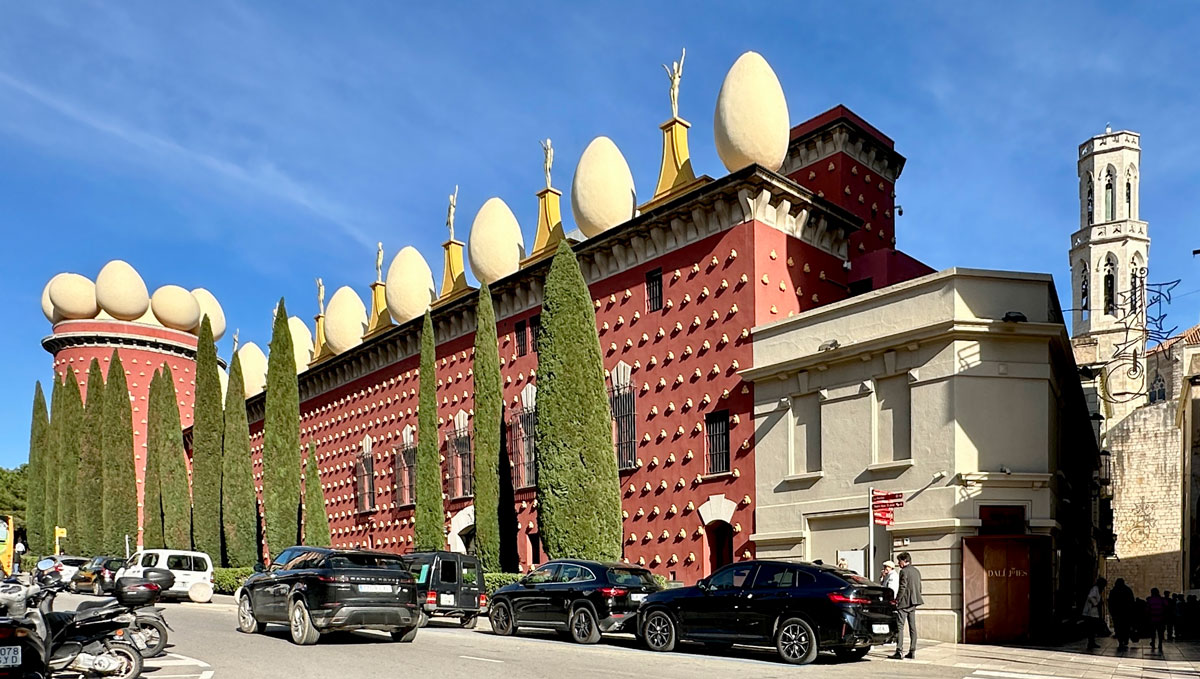
As we neared the museum, we turned a corner, caught a glimpse of the destination and were flabbergasted.There is no way to miss this building. It is a work of architectural art. A geodesic glass dome, designed by the architect Emilio Pérez, draws your eye to the top of the museum. Next, your eyes become fixated on the giant eggs that adorn the top of the structure, contrasting with the bright red walls. Moreover, small golden mannequins stand as surreal guardians in between the eggs, welcoming art patrons into this creative hub. Dali’s design utilized neoclassical foundations as well as avant-garde and surrealist influences.
Figueres Municipal Theatre
The Dali Theatre-Museum was the artist’s own vision and was literally built on the ruins of the old Figueres Municipal Theatre (Teatro Municipal de Figueres). The Theatre held special meaning for Dali, as this is where his first art exhibition took place – in the lobby. Unfortunately the venue was destroyed by fire towards the end of the Spanish Civil War. Dali conceived of this decade long project as a way to house his extensive collection which began in 1960s. The Dalí Theatre-Museum officially opened to the public in 1974. This was his vision. This would be his legacy, and Figueres was the city where he was born. His attention to detail on the building exterior is magnificent, and the treasures found inside are even more mesmerizing.
Art at the Dalí Theatre-Museum Figueres
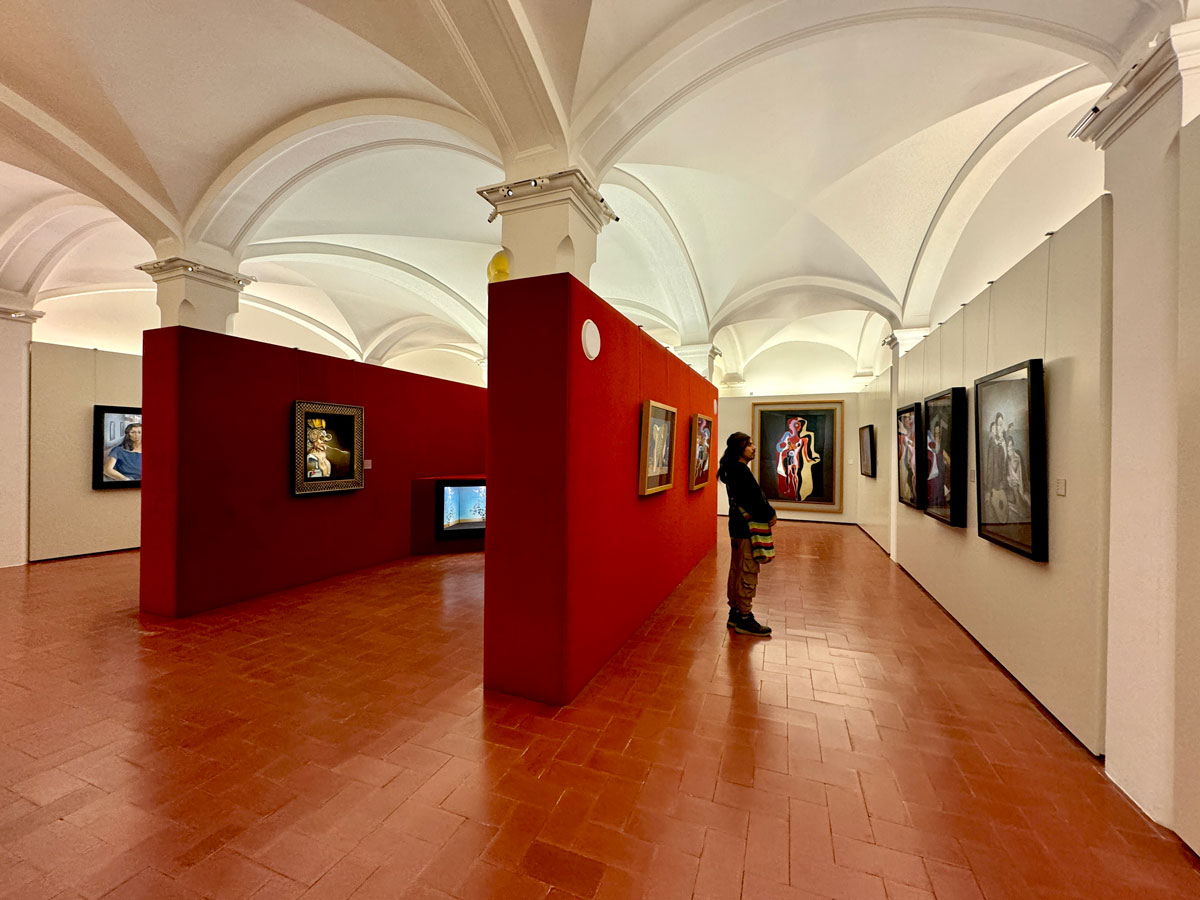
The museum includes a massive range of work – from academic studies to well known artworks and large installations. In addition to creating his own drawings, paintings and sculptures, Dali also collaborated with filmmakers, writers, and scientists. These works are also on view, along with an eclectic mix of both permanent and rotating exhibitions. Of course a multitude of works depict Gala, his wife and muse of 53 years. The Dali Theatre-Museum is also the site of Dalí’s final resting place. His crypt is located beneath the former theater stage which is downstairs and open to the public.
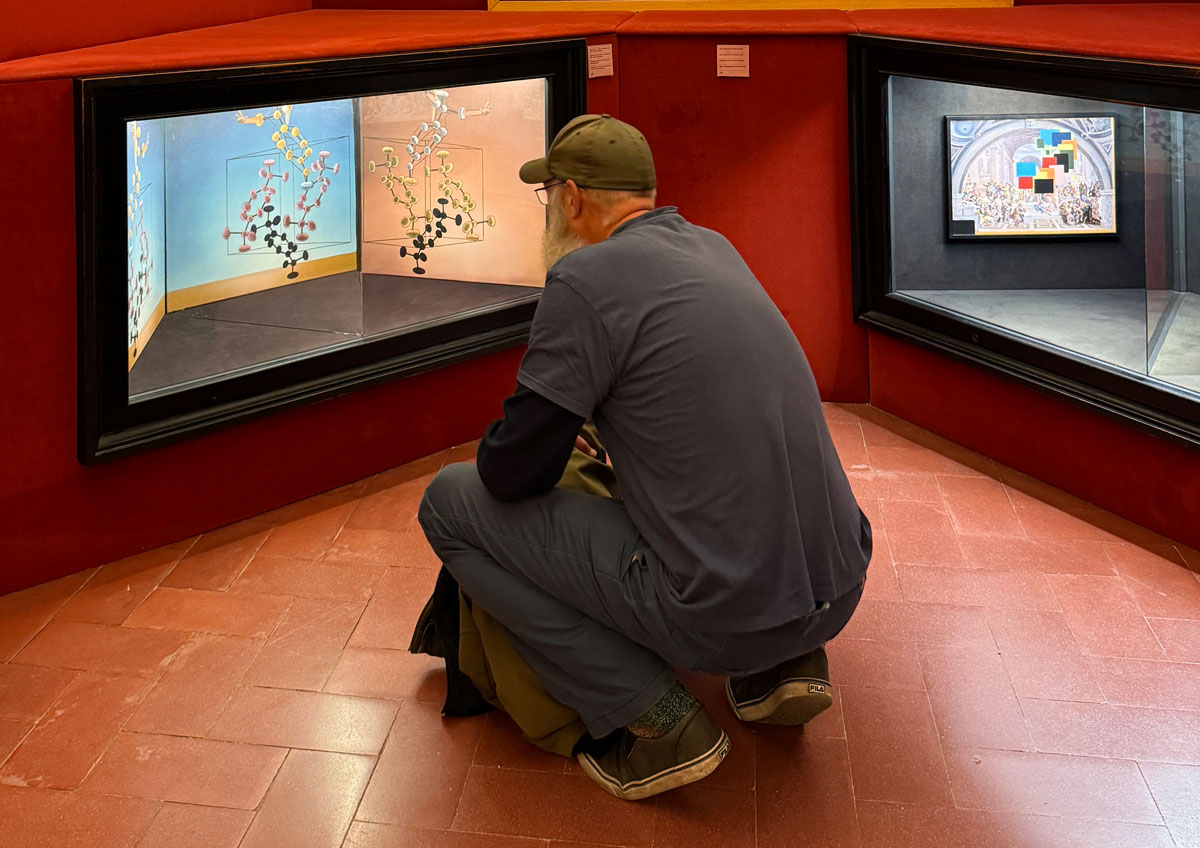
Dali’s work is all about perception, hence his use of anamorphic works and also holographic works. Examples of this include The structure of DNA, c. 1975-76 as well as Dalí Lifting the Skin of the Mediterranean Sea.
Rainy Taxi by Salvador Dali
A popular permanent installation titled Rainy Taxi can be found in the central courtyard. Upstairs, you can look through any of the interior windows to view the car from above. Rainy Taxi is a re-creation of an original piece by Dalí first exhibited in 1938 in Paris. It was part of the Exposition Internationale du Surréalisme. Then, in 1939 an additional re-creation of it was on exhibit in New York’s The Worlds Fair.
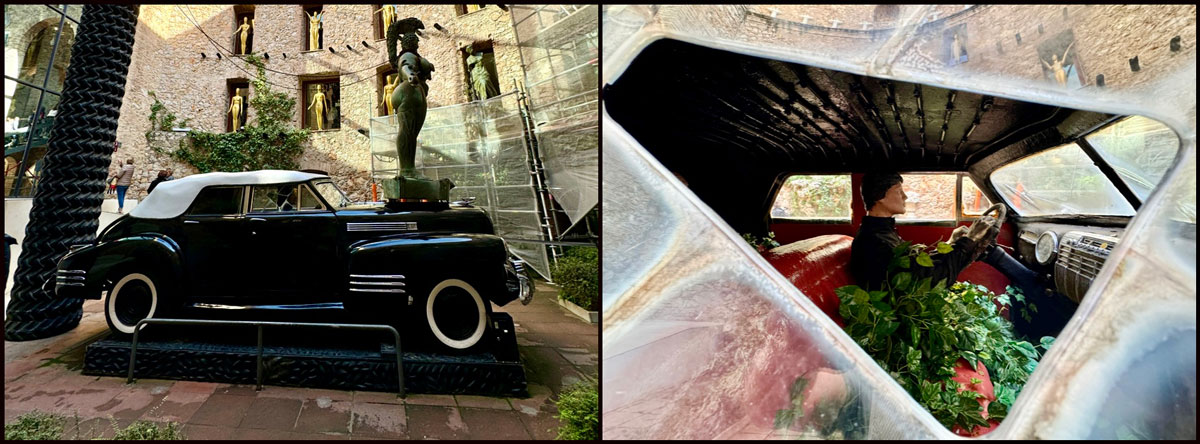
This version in the Dali Theatre-Museum was designed by Dalí himself as a permanent feature of the building. Atop of the taxi is a reproduction of Austrian artist Ernst Fuchs’ sculpture The Great Esther adding to the absurdity of the overall presentation. The mechanical sculpture includes a mannequin driver and offers viewers an option to make it “rain” inside the taxi for a small fee via a coin slot. Pipes were installed into the Cadillac so that water literally rains inside the cab. Above the car full size gold mannequins look down upon the automobile. Upside down fishing boats skewered on sticks high up in the air, symbolize Dali and Gala’s connection to the sea.
The Mae West Room
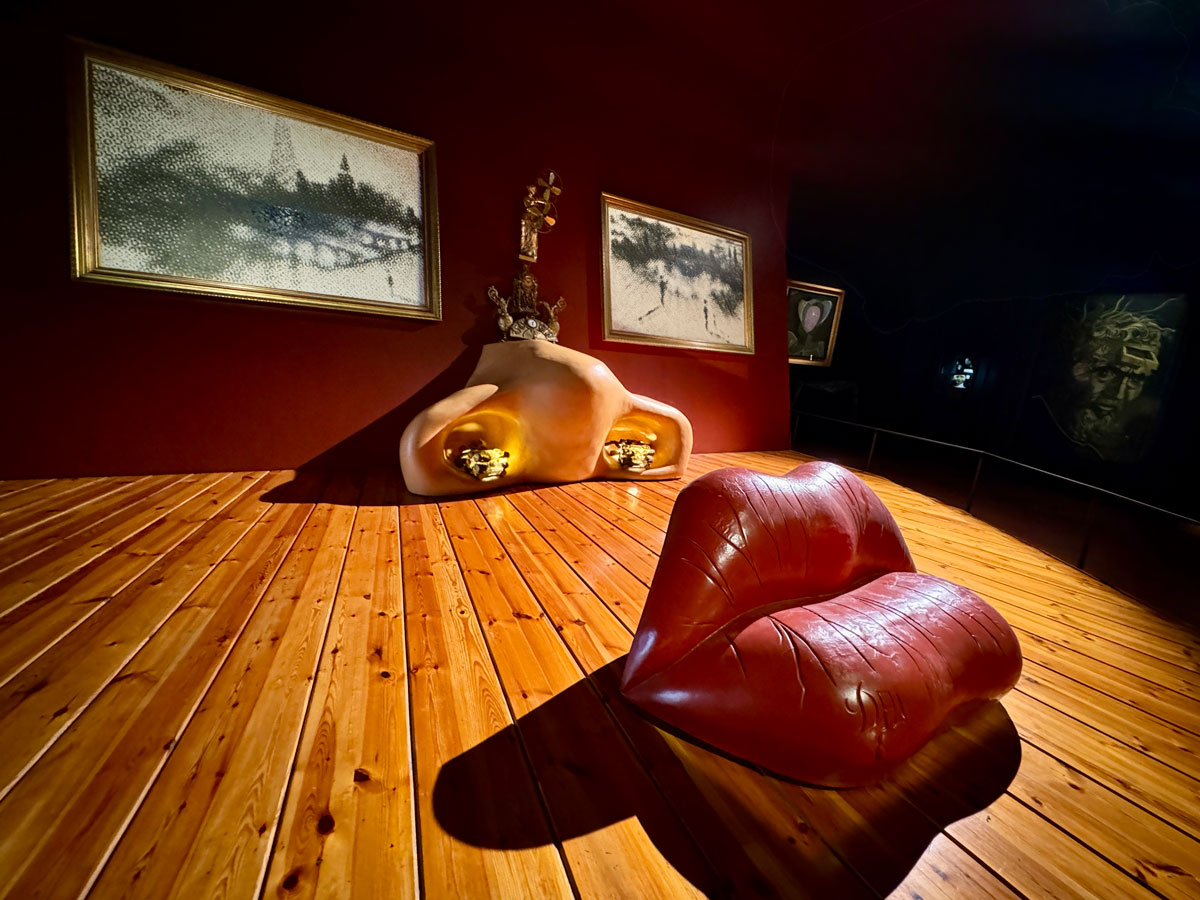
Another famed permanent exhibition at the Dalí Theatre-Museum is the Mae West exhibition. The artist was fascinated by Mae West, her fame, her hyperfemininity as well as her position in Hollywood. As we all know, Dali was a theatrical man himself. So it is no wonder that he looked at Mae West as a cultural icon. Therefore the Mae West room is a tribute of sorts. While the paintings of eyes on the walls establish the face, the nose fireplace and of course lip shaped sofa further expose her face. Curtains, not visible in the photo below, represent her hair. Dali created the Mae West Room as a surrealistic theatrical experience.
Palace of the Wind
I absolutely loved the Palace of the Wind fresco on the ceiling which lies above what used to be the stage of the original theatre. Now it sits above a re-creation of Dali’s private chambers. The mural represents Dali and his beloved Gala suspended in the sky. The wind symbolizes life’s force, while the “palace” represents Dali himself. Adjacent to that room was another presentation of Dali’s home life, the bedroom. Here, above the bed is a tapestry with a reproduction of The Persistence of Memory, one of Dalí’s most recognized works. It features the famous melting clocks amidst a dreamy landscape.

Dalí Theatre-Museum‘s Notable Artworks
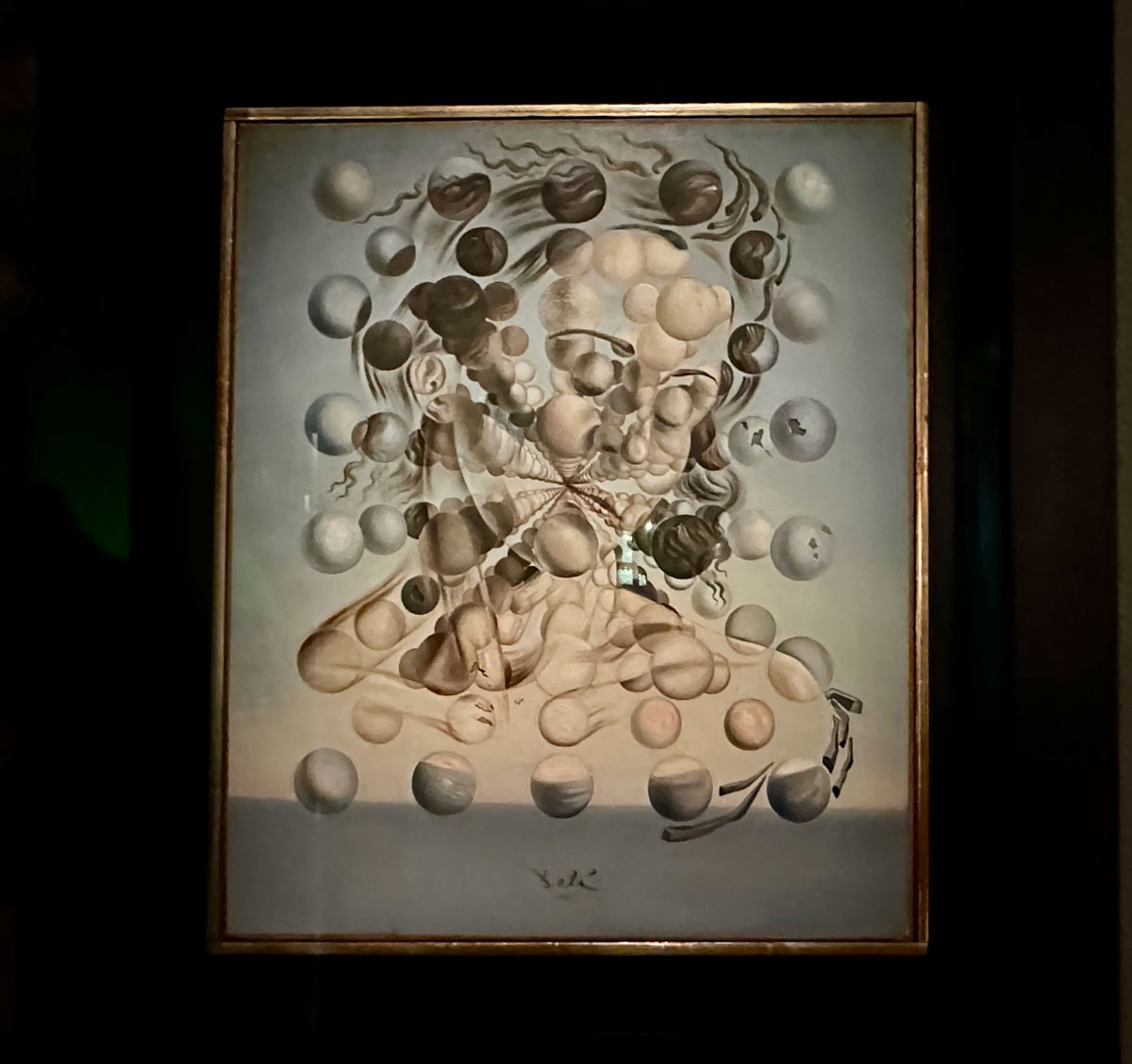
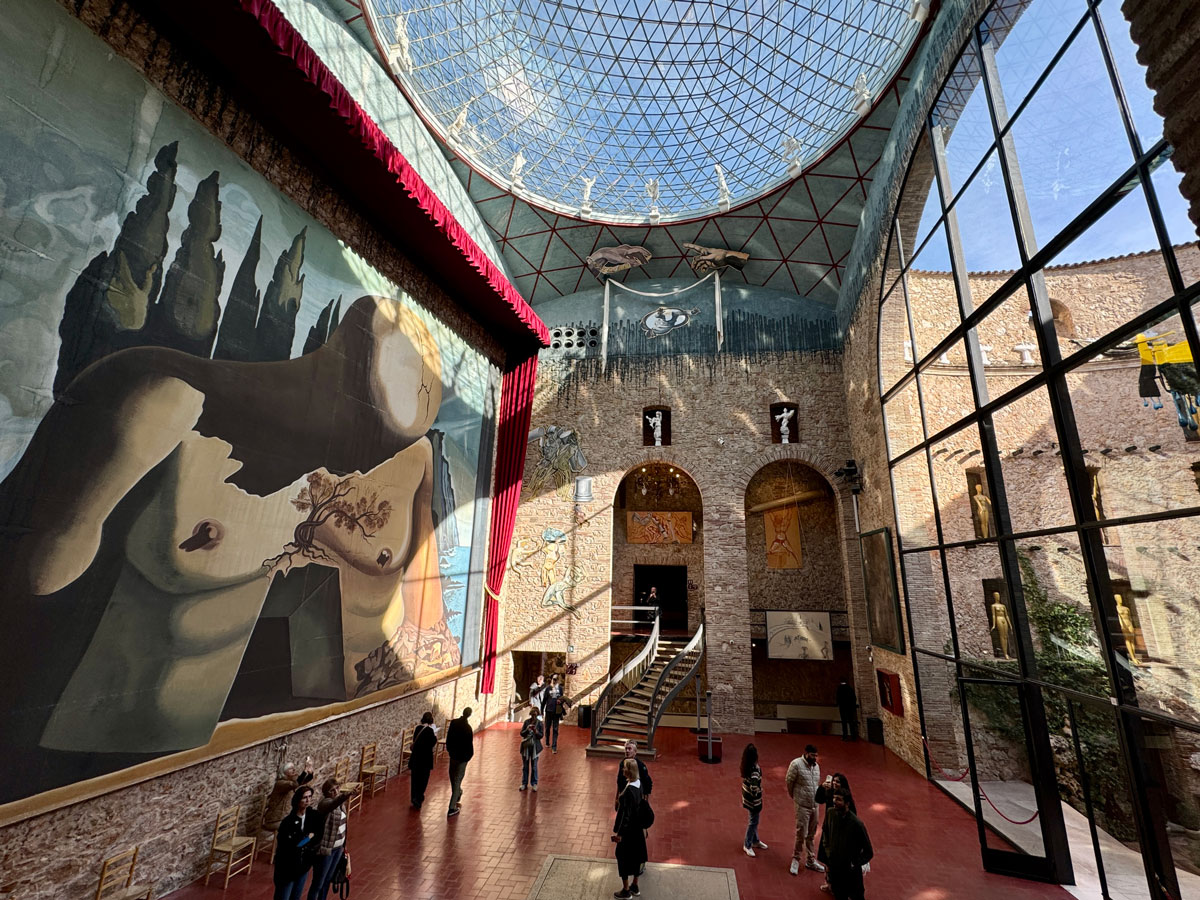
I also can’t say enough about the main lobby (pictured at top of this article). One could dive down a surrealistic worm hole discussing the symbolism as well as subtle nuances. Moreover, each room of the museum carries the weight of Dali’s vast talent. Hundreds of works from various series are on exhibit. Lastly, two notable artworks on view at the Dalí Theatre-Museum are Galatea of the Spheres (see image at bottom) and Leda Atomica.
Galatea of the Spheres unites Dali’s passion for art and science with his love for Gala. Dali created the work during his nuclear mysticism period. The title is inspired by Greek Mythology. The suspended spheres surrounding Gala represents the structure of atoms. Dali incorporates both Renaissance style with modern science.
If you are an art lover and you find yourself anywhere near the Girona province of Spain, the Dali Theatre-Museum is a must-see attraction. The museum is only an hour and a half away from Barcelona. Find out more on the website – https://www.salvador-dali.org
Be sure to read my Eden Roc Hotel & Spa by Brava Hoteles Review. The hotel is located in the small coastal town of Sant Feliu de Guíxols in the Costa Brava region of Spain. This is where we stayed during our visit to Costa Brava, Girona and Cadaqués.