The Best Underwater Photographs of Marlin
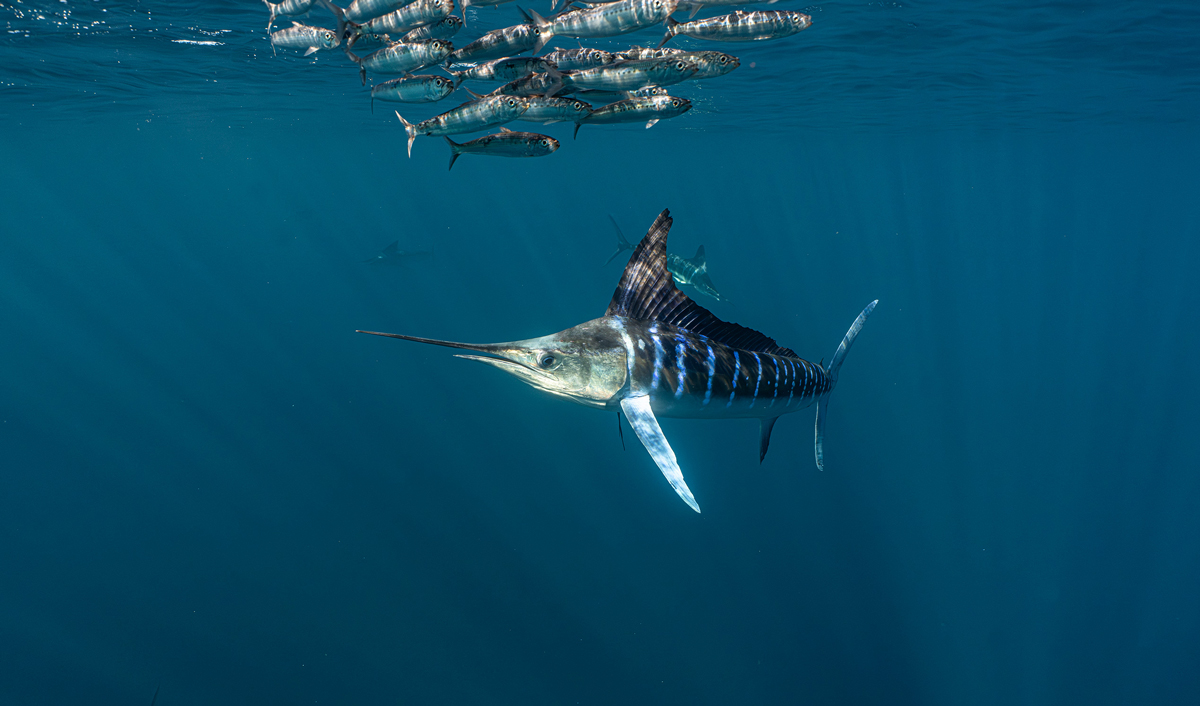
Best Underwater Marlin Photographs
Each Autumn thousands of marlin gather to feed in the Pacific ocean, just outside Magdalena Bay, Mexico. Many people consider the blue water zone outside Magdalena Bay to be the best place in the world to swim with feeding marlin. Located on the western side of the Baja Peninsula, the town of Puerto San Carlos is a great launching point to witness the action. As a professional photographer, I can tell you it is also THE go-to spot to catch the best underwater marlin photos.
Tours to swim and snorkel with the marlin begin in October and run through December most years. As long as the weather is good, and the wind is not too strong, the boats go out. The fish are relatively easy to find. There is no guarantee that you will see them, but the probability is quite high. In fact, there are numerous boats out searching every day during the season. They keep in touch with one another and work together to help locate the fish.
Best Magdalena Bay Tour Company, Photographing Marlin
The best tour company to book your marlin snorkeling adventure with depends on your personal goals and your budget. As a professional photographer who dreamed of swimming with billfish for over 20 years, this trip meant more to me than it does to most people. To maximize my chances of having a great experience, I made all the arrangements myself. I sell large scale prints of my photographs, so I needed as much control as possible over all aspects of my trip. This required me to hire a private guide.
Private Marlin Charters Versus Large Tours
I was determined to spend time alone in the water photographing the fish. All the tour companies I found online bring groups of at least 6 people on their boats. These small tours specialize in getting underwater photographers in the water with feeding marlin. Since this was a bucket list experience for me, being in the water with 5 other photographers was not what I wanted.
I researched various options. Then a friend gave me the contact info for a local fisherman. After much consideration, I chose a private charter with Enrique and his brother Pepe. They have been fishing these waters since childhood. About 10 years ago they started getting requests from people who wanted to swim with and photograph feeding marlin. Now, the brothers offer marlin and other tours out of Puerto San Carlos. They both speak English, and they are more than capable of running marlin tours. These guys can spot “static bait balls” way off in the distance. This is the key to having a great experience. They can read the behavior of the birds, sea lions, dolphin, fish and marlin to determine where your chances of having the best encounter are most likely.
What Works Best for You
Captain Pepe had me in the water with numerous marlin 3 out of 3 days. While I cannot tell you which company is the best, I can tell you that I had an awesome time with captain Pepe. Enrique owns the company, and he responds pretty fast when you send him a message via WhatsApp +52 613 118 0217. Reach out to Enrique a few months before you plan to go, so he can reserve one of his boats and a captain. If you convince a few friends to go with you, chartering the boat can be cost-effective.
If you don’t feel safe doing it this way, book with one of the various tour companies. I have a friend who likes going with Nomad and Nautilus. They have taken out some really famous photographers. I was shocked to discover that swimming with marlin is really popular, and the local captains get fully booked. These exotic tours are more well-organized than you might imagine. Due to the excellent communication between all the captains, help is likely available rapidly if needed. Enrique and Pepe have satellite connection for their phones.
Safety while swimming with feeding marlin
Swimming and snorkeling with feeding marlin is a lot safer than it seems. A marlin’s bill looks like a sword that could easily impale you. However, a marlin would never intentionally impale a large animal with its bill. The bill is primarily used to swat and stun small fish. The marlin suck up the weak and disoriented bait fish. They don’t spear anything. That said, there are circumstances where the risk of being injured must be considered.
As a basic precaution, never get in the middle of a large bait ball. You might end up hidden from view as several marlin dash through to catch their prey. Also, consider getting out of the water, if there are only a handful of bait fish left for the marlin to eat. The bait will use you for shelter, and the marlin will swim within inches of your body to catch them. The marlin are incredibly precise, but common sense should tell you the risk of getting hit increases dramatically at these times. If you keep a safe distance, a marlin will almost certainly not accidentally or intentionally bump into you.
Is it difficult to photograph marlin from underwater?
Photographing marlin from underwater is not particularly difficult when you find them feeding during fall near Magdalena Bay. The reason is that the fish are abundant here, and their behavior is predictable. They congregate over high spots, where massive amounts of bait fish are found. The natural annual event is described as the Mexican sardine run.
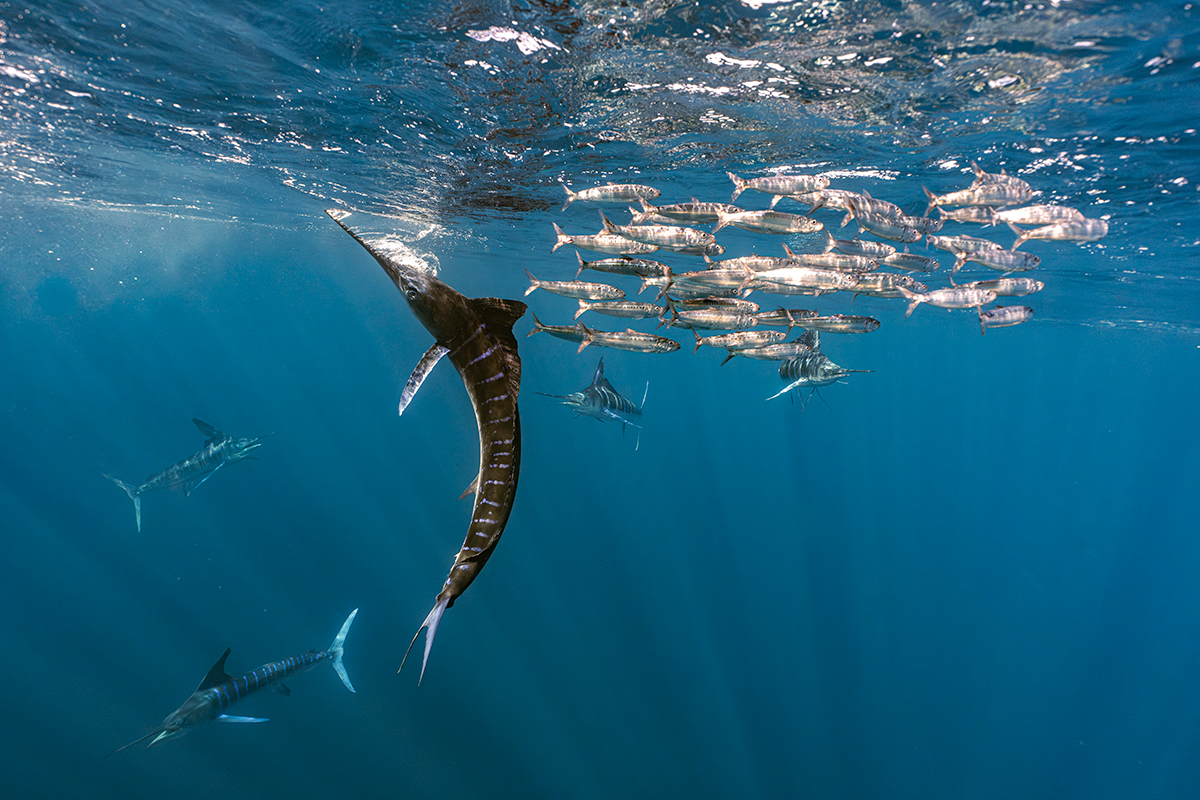
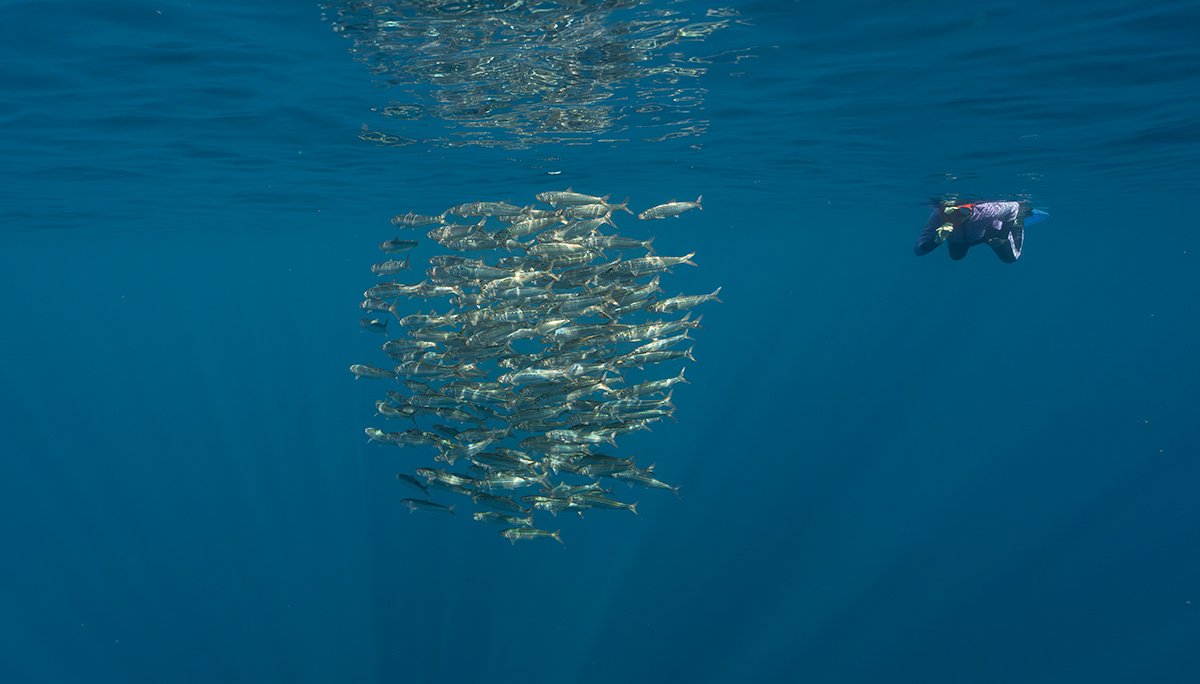
If you are lucky enough to find a static bait ball, you can remain at a safe distance, relax, and watch the feeding take place. A static bait ball is a group of small fish surrounded by predators, essentially trapped and held in one place. More often than not, there will be several or many marlin feeding on these small fish. When the bait is surrounded and being held in one place, you do not need to swim after them. You just jump in the water, swim calmly towards the ball and watch the marlin feed. As the marlin take turns eating, some will swim right past you.
Shooting the Best Marlin Videos
Capturing beautiful videos to share is relatively easy. Hang back, point your camera at the bait ball and press record. Let the action unfold in front of you rather than try to follow it. Shoot at 60 frames per second or higher, so you can slow your footage down later. If your group rushes frantically towards a bait ball, the marlin might hang back allowing the bait to dive down. That can easily end your encounter. While capturing video is relatively easy, shooting still images is much more challenging. The marlin tend to be moving briskly or very fast. Then they burst at high speed through the bait balls. Shooting with a wide angle field of view will increase your chances of keeping the fish in frame. If capturing and creating still photos is your goal, study the techniques and equipment used by professional underwater photographers before your trip.
best camera for photographing feeding marlin and bait balls
The best camera for photographing and filming marlin depends on how you plan to use your photographs and videos. For the vast majority of people, the best camera for photographing marlin from underwater will be a cell phone camera with the phone protected in a waterproof housing or an action camera. All the popular brands will produce beautiful images, as long as they are relatively new. Phones and action cameras are easy to pack, easy to use, budget friendly and good enough to record and share your memories.
Iphones Underwater
The marlin feed at the surface of the water where there is a lot of light. These cameras perform very well in bright conditions. I personally love using my cell phone camera, because this makes sharing the photos and videos super easy. That said, professional photographers and serious photography enthusiasts will want to use more professional equipment. The best camera for photographing marlin underwater does not really exist. Every major brand has models that are capable of capturing the action.
Sony A1 for underwater Marlin photos
I chose the Sony A1 for numerous personal reasons. Whatever brand you prefer select a model capable of rapid continuous shooting at very high shutter speeds with good low light performance. You will need fast memory cards and a wide angle or fisheye lens behind a dome port. The investment can become significant. If you do not have a genuine need for extra high-quality photographs and videos, traveling with this type of equipment is probably not worth the effort and investment.
Cell phone cameras and action cameras are a better choice for the vast majority of people. If you reach out to Mark Strickland at Bluewaterphotostore.com he will help you evaluate the options. He can also obtain whatever equipment you decide you want. His depth of knowledge is amazing, and he is incredibly honest. You can even join a tour through Bluewatertravel.com, if you are able to plan far enough in advance.
Boat ride to find the Marlin
When the first tours begin in October, the marlin are sometimes found just north of Puerto San Carlos. As the season progresses, the fish move south. They follow the abundant bait, as cooler water moves in from the north. The majority of boats which transport guests to swim with the marlin are relatively small pangas, 25 to 30 feet long. They carry 6 to 10 passengers. Expect to travel for 1 to 2 hours to reach the feeding grounds. More often than not, conditions are good enough for the tours to run, and the boat ride takes you past beautiful islands. It is actually a very nice journey. You may see humpback whales, turtles, dolphin and sea lions along the way. The ride back tends to be windy. So, bring a jacket.
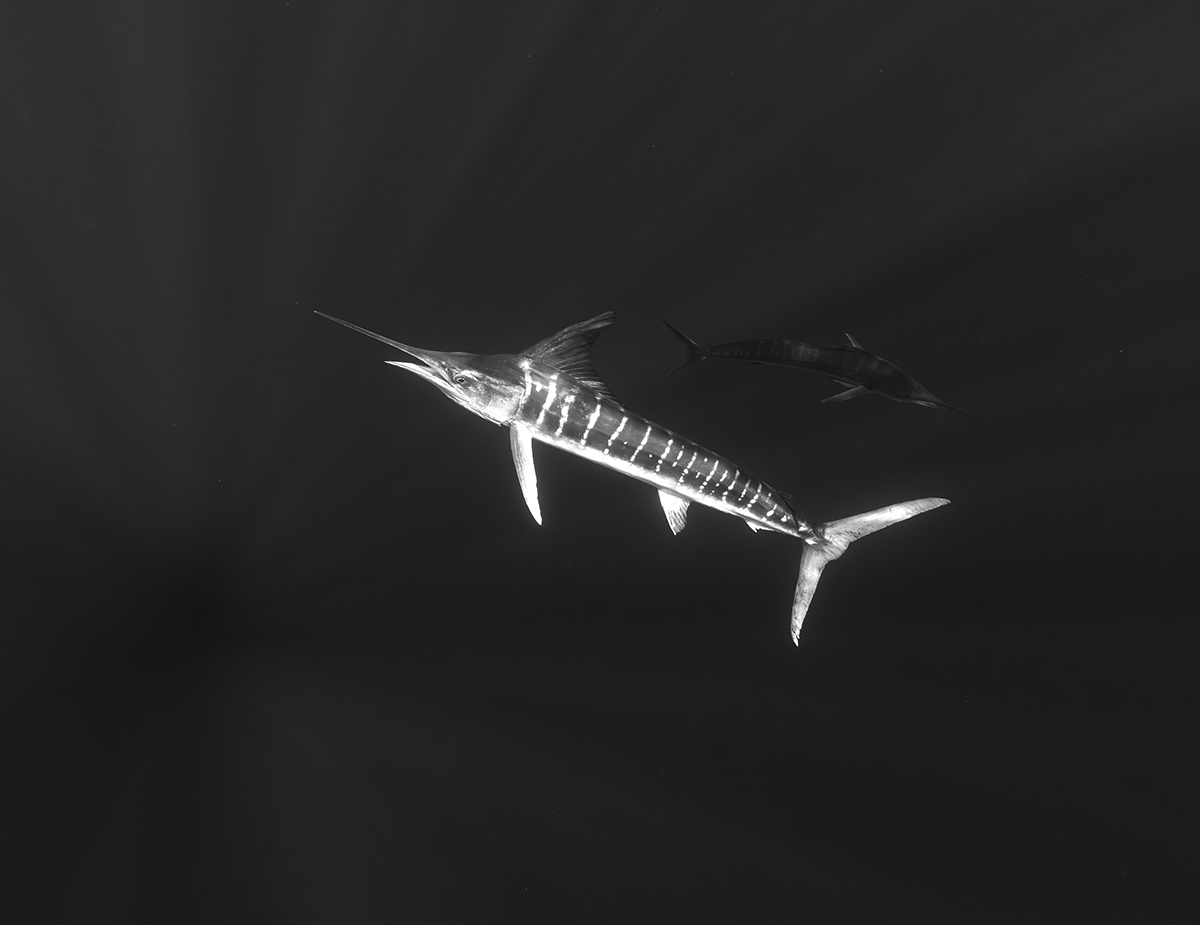
How close do the marlin get to you?
Exactly how close the marlin get to you depends a bit on the amount of bait in the water during your swim. You can more easily keep a safe distance, when the bait ball is not too large but also not too small. If you enter the water with marlin feeding on a very small bait ball, there is a good chance the bait will seek shelter around your body. When this happens, the marlin will most likely get extremely close to you. For most people, this situation is intimidating and potentially dangerous.
My personal opinion is that you should get out of the water and go look for a larger bait ball. I will admit that some of my best photographs were taken during these swims. However, I am not certain it was particularly wise for me to have pushed the limits as far as I did. I got away with it and got great shots. However, I do not think I will push my luck and do it again.
Large Bait Balls
When you find a huge bait ball, there is another type of risk that must be considered. If you jump in the water with a very large bait ball, you are well-advised to keep your distance. A wide array of predators are potentially hunting the bait ball. These predators include sea lions, dolphin, sharks, tuna, dorado, marlin, and whales along with other pelagic fish. While witnessing the feeding can be extraordinary, the dynamic nature of this scenario creates an unpredictable situation. The baitfish are frantically trying to escape being eaten. You cannot possibly swim away from the bait. If it comes rushing towards you, it may very well surround you.
Since Byrde’s whale are frequently hunting from deep below, they can appear rapidly and unexpectedly. When this happens, the entire bait ball attempts to get away at the last second. The one place you do not want to be at that moment is obstructed from view in the middle of the bait ball. You also do not want to be in there when marlin, sharks or any other predators dash through the bait.
Keep your distance, if you end up in the water with a large bait ball. I personally ended up surrounded by bait and actually got bumped by a whale. I was very lucky, that I did not get injured. Had I kept my distance, I would not only have witnessed the feeding, I would have captured photos of the whale. As it turns out, I interfered with the whale’s feeding, and I denied it a meal. Next time, I will keep my distance.
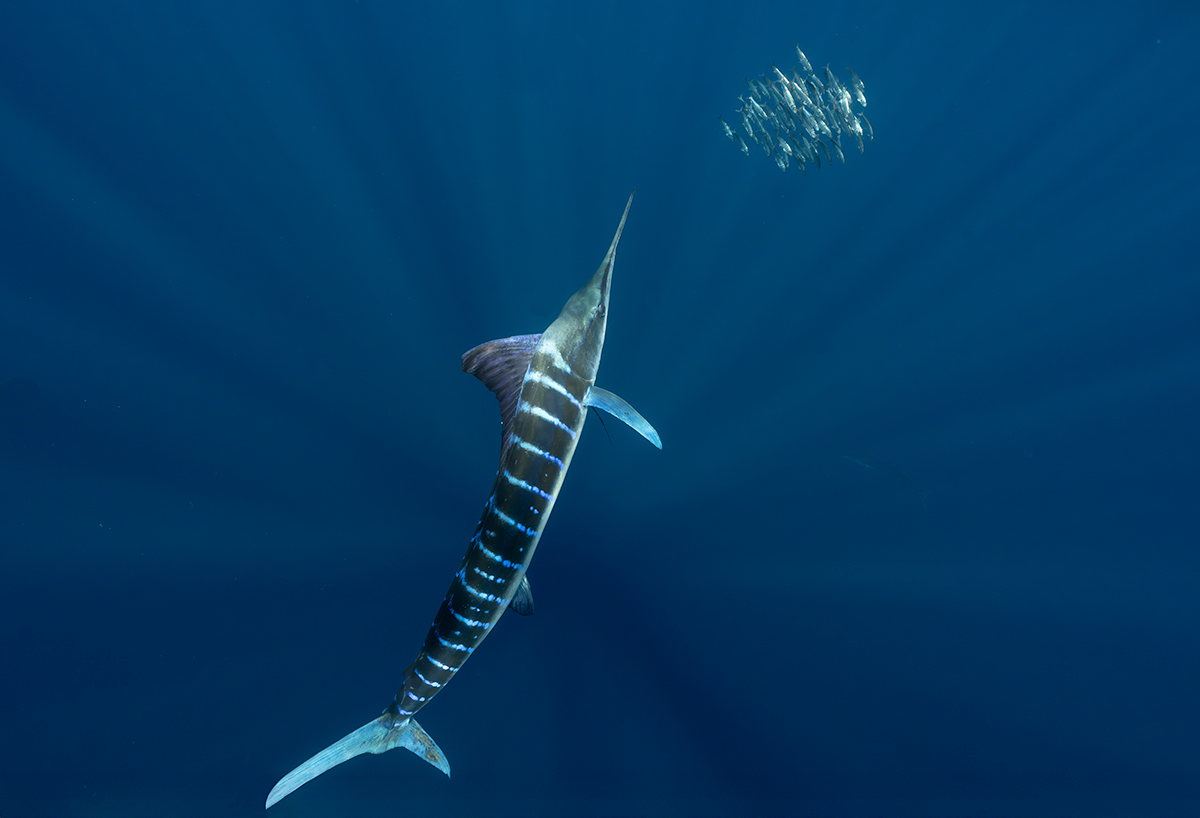
Is it expensive to snorkel with marlin?
Joining a tour group to snorkel with the marlin is not particularly expensive. There are day tours and overnight tours, so you can join a group. However, there are a lot of additional expenses to be considered. Most of the tours depart from Cabo San Lucas or La Paz. The boats primarily leave from Puerto San Carlos, while some leave from Puerto Chale. Both towns are quite far from Cabo and La Paz.
Neither of these small towns are close to an airport. You will almost certainly fly into Cabo San Lucas, La Paz or Loreto. Then you will need to get to one of those two towns. If you want to snorkel with marlin, your best bet will be to book a tour with one of the companies located in those towns. They will transport you to the Magdalena Bay area and provide some type of accommodations. Each morning, bright and early, they will take you out searching for feeding marlin.
Lodging With or Without a Marlin Tour Company
There are a few hotels and a few comfortable camping options. The well-established tour companies make the experience more comfortable than you might imagine. To increase your chances of having a great experience, book no less than three days on the water. A 5 day trip is ideal. The reason is simple. You don’t want to go all that way and end up there when the weather is bad. The weather during fall just outside Magdalena Bay is rarely bad for more than 3 days in a row. If your tour includes 3-5 days on the water, you will almost certainly be able to get to the feeding grounds. If weather is good the whole time, you will have a magical experience you will never forget.
The bottom line is that snorkeling with marlin requires a budget of a few thousand dollars or more, even if you drive there and make all the arrangements yourself. If money is not a limiting factor, consider booking a multi day liveaboard trip. You will be staying on a large comfortable boat, eating amazing meals, and going out each day without a long boat ride to the feeding grounds. Alternatively, camp on the island for a slightly shorter boat rides and a more spiritual experience. Staying in a hotel in Puerto San Carlos is a bit more comfortable. I chose to stay in a hotel, so I could get the best sleep possible and rinse my camera gear in the shower. No matter how you make it happen, swimming with marlin is something special that you will never forget.
Find out more on the ETG Mexico Page. If you are a thrill-seeker, visit the ETG Adventure Page or the ETG Natural Wonders Page.